

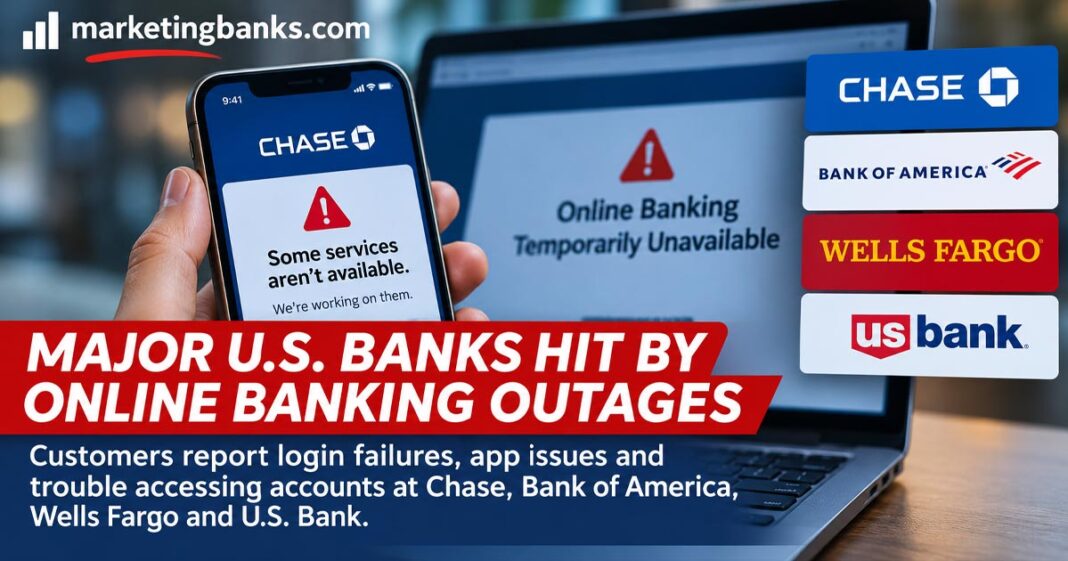
Chase, Bank of America, Wells Fargo and U.S. Bank were among several major financial institutions experiencing reported online banking problems Monday, November 16, raising fresh concerns about the reliability of digital banking services and how financial institutions communicate with customers during disruptions.
Customers began reporting problems around 9 a.m., with complaints appearing on Downdetector involving mobile banking apps, online account access, account balances and money transfers. Reports also surfaced involving J.P. Morgan and Zelle, suggesting that the disruption was being felt across multiple banking platforms, although a common cause had not been established.
The problems come at a time when consumers increasingly depend on mobile apps and online banking for everyday financial transactions. For banks and credit unions, even a relatively short disruption can quickly become a customer service problem, particularly when customers cannot access their money or get reliable information about when services will return.
Chase, Bank of America and Wells Fargo See Thousands of Customer Complaints
Chase appeared to be among the hardest hit, with 4,380 reports recorded by 1:30 p.m. Eastern, while Bank of America had received 1,244 reports. Wells Fargo recorded 511 complaints as of 1:45 p.m. Eastern. Another outage tracker later showed nearly 10,000 reports involving Chase.
The complaints covered a wide range of banking services. Chase customers reported being unable to log into their accounts, view balances, access the mobile app or complete transfers. Some users also described problems cashing checks, withdrawing funds and obtaining cashier’s checks. Reports involving other financial institutions included difficulties accessing mobile banking applications and using ATMs.
While Downdetector reports can provide an early indication of widespread service problems, they reflect customer-submitted complaints rather than a verified count of affected accounts. The number of reports also does not necessarily indicate how many customers were unable to access their accounts.
Still, the volume of complaints across several major financial institutions quickly drew attention and increased pressure on banks to explain what was happening.
Banks Acknowledge Problems as Customers Look for Answers
Chase and Wells Fargo acknowledged service disruptions, although neither had provided a detailed public explanation of the cause in the information available at the time of writing.
Chase Support responded to a customer on X, confirming that the bank was working to resolve an online banking issue. Customers attempting to access the Chase app also encountered a notice stating that some services were unavailable.
Wells Fargo displayed a message on its website informing customers that online banking was temporarily unavailable.
Bank of America and U.S. Bank had not issued public statements identified in the initial reporting, despite customers reporting problems accessing their services.
For financial institutions, the way these disruptions are communicated can be almost as important as how quickly they are resolved. When customers cannot access their accounts, they want to know whether their money is safe, whether scheduled payments will still process and when they can expect normal service to return.
A generic error message or unexplained login failure offers little reassurance, particularly when customers are seeing thousands of similar complaints across social media.
Banking Problems Follow a Series of Major Technology Disruptions
Monday’s reported banking outages followed several high-profile technology and infrastructure disruptions in recent days, including a Microsoft service outage on Friday that affected products such as Outlook, Teams and Copilot, as well as a separate FAA communications disruption that resulted in a nationwide flight ground stop.
There has been no confirmed connection between those incidents and the banking problems reported Monday. The cause of the banking disruptions also remained unclear.
Nevertheless, the incidents illustrate how dependent major industries have become on digital infrastructure and how quickly technical problems can interfere with services that millions of Americans use every day.
For financial institutions, this dependence extends well beyond consumer-facing websites and mobile apps. Digital banking platforms rely on multiple interconnected systems, including authentication services, payment processing networks, cloud infrastructure, third-party technology providers and internal banking systems. Problems anywhere along that chain can potentially affect the customer experience.
The growing reliance on technology also means that operational resilience is no longer exclusively an IT issue. It has become an important part of customer confidence, brand reputation and long-term retention.
What Banks and Credit Unions Can Learn From the Outages
For bank and credit union marketing teams, service disruptions present a communications challenge that should be addressed long before an outage occurs.
Customers generally understand that technology can fail. What creates lasting frustration is being unable to get answers, receiving conflicting information or feeling that their financial institution is not taking their concerns seriously.
There are several areas where financial institutions can improve their response.
- Communicate early and consistently. Customers should not have to rely on Downdetector or social media speculation to determine whether their bank is experiencing problems. Even a brief acknowledgment can help reduce confusion while technical teams investigate.
- Use multiple communication channels. Website alerts, mobile app notifications, email, social media and contact center messaging should provide consistent information. Institutions should also have alternative communication options when their primary digital platforms are unavailable.
- Explain what services are affected. Rather than simply announcing technical difficulties, banks should identify which services are experiencing problems and, when possible, explain whether debit cards, ATMs, direct deposits and scheduled payments remain operational.
- Anticipate fraud attempts. Criminals can exploit confusion surrounding outages by sending fraudulent account verification messages or impersonating customer support representatives. Banks should remind customers that they will never ask for passwords, PINs or one-time verification codes through unsolicited communications.
- Prepare customer-facing employees. Branch staff, contact center representatives and social media teams need accurate, consistent information so customers receive the same answers regardless of which channel they use.
- Follow up after service is restored. Customers should receive confirmation that systems are functioning normally, information about any outstanding transaction issues and instructions for requesting assistance if the disruption resulted in fees or missed payments.
Digital Banking Reliability Is Part of the Customer Experience
Financial institutions have spent years encouraging customers to adopt digital banking, promoting the convenience of managing money anytime and from anywhere. Mobile deposits, instant transfers, digital account opening and around-the-clock account access have become standard expectations rather than optional features.
That convenience also creates a greater responsibility to maintain reliable systems and communicate effectively when something goes wrong.
An outage affecting a major institution such as Chase can generate thousands of complaints within hours. For smaller community banks and credit unions, the scale may be different, but the potential damage to customer confidence is just as significant.
For bank and credit union marketers, the lesson is straightforward: crisis communications need to be treated as part of the overall digital banking experience, not something developed after customers begin reporting problems.
Financial institutions that respond quickly, explain what is happening and keep customers informed have a better opportunity to preserve trust. Those that leave customers searching social media for answers risk turning a temporary technology problem into a much longer-lasting reputation problem.