

The headline your members just read
The next big trust test for financial institutions isn’t a data breach. It’s a bot your member invited in.
On October 22, 2026, Axios reported that major U.S. banks are detecting unauthorized third-party AI agents inside customer accounts, and that some of those agents are attempting actions that appear independent of what the customer asked them to do. Morgan Stanley, Bank of America, JPMorgan Chase and Wells Fargo are among the institutions reported to be racing to contain the risk. Executives told Axios they struggle to tell a human from an agent, and an authorized agent from a rogue one. Several are now planning “day after” scenarios for securing or restoring accounts if something goes wrong.
That story will reach your account holders through local TV, social feeds and the group chat, usually stripped of nuance. The institutions that speak first, plainly and calmly, will keep the trust. The ones that stay silent will let the headline speak for them.
Why this isn’t just a megabank problem
The story names Wall Street banks, but the mechanism is universal. According to Cybersecurity News, the access typically begins when a customer hands an AI assistant their banking username and password. No hacker breaks in. The customer opens the door, often violating terms that require people to log in themselves.
Any institution with online banking can face that same scenario, and community banks and credit unions usually have fewer fraud analysts and less behavioral-detection tooling than the largest banks. The reported behaviors also reach beyond the app: KRON4 noted agents contacting call centers on their own, which puts the branch and contact center on the front line.
It’s important to read the story precisely. Reuters said it could not immediately verify the findings, and Morgan Stanley told Axios it had not seen rogue agents on its platforms. The coverage describes attempted actions and executive concern, not confirmed widespread theft. That nuance is exactly what your members won’t get from a headline, and exactly what you can give them.
The questions coming to your branches and inbox
Expect a mix of anxiety and confusion, often from people who already use AI assistants. Plan answers for these five:
- “Is a robot in my account right now?” Most members have never connected an agent and need to hear that plainly.
- “I gave my AI app my login. Am I in trouble?” These members need a no-shame path to fix it, not a lecture.
- “If an AI moves my money by mistake, who pays?” Liability is the unspoken fear. Crypto Briefing noted the economics shift sharply if losses from customer-authorized agents land on the customer.
- “Will you block the budgeting tools I rely on?” Members who use aggregators worry about losing convenience.
- “Is my bank or credit union using AI on me?” Trust questions spill over to your own chatbots and fraud models.
A reassurance playbook for the next 30 days
Reassurance only works if it’s specific and backed by real controls. Coordinate with your security, compliance and digital teams first, then move on these fronts.
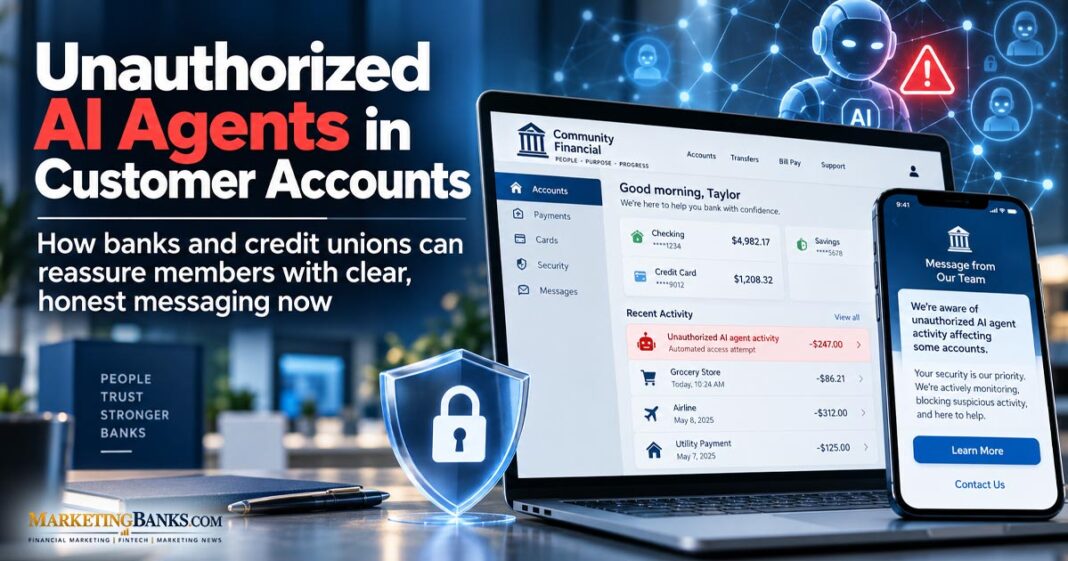
1. Say something within the week. A short member notice beats silence. Lead with what’s true at your institution: whether you allow third-party agents, what you monitor, and how to reach you. Post it in online banking, the app’s message center, email and your social channels.
2. Give one clear rule. Echo the advice a Chase spokesperson gave Axios: never share your username and password with anyone, including an AI app. One memorable line travels further than a policy page.
3. Offer a safe alternative, not just a “no.” Most large banks are moving toward read-only access for outside tools, letting them view balances without moving money. If you support approved data connections, tell members how to use them. If you’re building toward that, say so.
4. Make cleanup easy and shame-free. Publish three steps for members who shared credentials: change the password, turn on multifactor authentication, and review recent activity and linked apps. Invite them to call, and promise a human answer.
5. Brief the front line first. Tellers, call-center staff and member service reps will field these questions before marketing sees them. Give them a one-page script, an escalation path, and a way to verify a caller who may be an agent rather than the member.
6. Show your “day after” readiness. The largest banks are rehearsing how to secure and restore accounts after an incident. Without revealing security details, tell members you have a plan to lock, review and restore access quickly.
7. Be honest about your own AI. If you use AI in chat, fraud detection or marketing, explain where and how a human stays in charge. Transparency here inoculates against the broader fear.
8. Use the moment to educate. Fold agent safety into existing fraud-awareness content, financial-literacy workshops and new-account onboarding. Credit unions in particular can lean on their education mission.
What not to say
The wrong reassurance can do more damage than none at all.
- Don’t promise it can’t happen here. Absolute claims age badly, and examiners and plaintiffs’ lawyers read marketing copy too.
- Don’t blame members. Many connected an AI app in good faith. Scolding drives them away from asking for help.
- Don’t overstate the threat. The reporting describes attempted actions, not confirmed mass losses. Fear-based copy erodes the calm you’re trying to build.
- Don’t make liability promises marketing can’t keep. Anything about who covers losses must come from compliance and legal, and match your account agreement.
- Don’t trash AI. Members will keep using these tools. Position your institution as the safe guide, not the scold.
The trust advantage is up for grabs
Bank executives told Axios they know they’ll need a middle ground with AI agents, because customers aren’t going to stop using them. That makes this a positioning moment, not just a risk moment.
Community banks and credit unions already win on trust and personal relationships. The institution that explains AI agents clearly, offers a safe way to use them, and has a real person ready when something looks off will turn a scary headline into a reason to stay. Start with a short member message this week, and build the longer story from there.